WHAT IS THE P-SSCRM’S PURPOSE?
We created the P-SSCRM to learn how software supply chain risk management initiatives work and to provide a resource for people looking to create or improve their own software supply chain risk management initiative. In general, every firm creates its software supply chain risk management initiative with some high-level goals in mind. The use of the P-SSCRM framework is appropriate if your business goals for software security include:
The Proactive Software Supply Chain Risk Management (P-SSCRM) framework is not a new standard. Rather than introducing any new concepts, practices, or controls, we have aggregated concepts, practices, and controls from existing software supply chain security frameworks.
- Informed risk management decisions
- Clarity on what is “the right thing to do” for a holistic set of roles involved in software supply chain security based upon the guidance referenced in the framework
- Improved software and associated supply chain security and compliance assurance.
The P-SSCRM framework provides the structure for a “descriptive” model. That is, P-SSCRM is
not a prescriptive model that recommends what an organization should do to reduce software
supply chain risk. Instead, P-SSCRM provides information on what the organizations that have
undergone a P-SSCRM assessment are doing. Put another way, P-SSCRM is not a set of best
practices defined by some committee for some one-size-fits-all generic problem. Rather, P-SSCRM
is a set of actual practices being performed daily by forward-thinking firms.
WHERE DID THE P_SSCRM COME FROM?
RISK MANAGEMENT ROLES
- Business Manager: This grouping of roles includes compliance, risk, and vendor managers.
- Architect/Developer: This role designs, implements, and tests a software product.
- Information Technology (IT): This role provides the hardware, software, and services infrastructure to enable an organization to receive, store, retrieve, transmit, and manipulate data.
- DevOps: This role provides the technology for deploying, delivering, and operating software applications and services through the integration and collaboration between development teams and operations teams.
- Software Security: This role creates and facilitates processes and procedures for secure software development at an organizational level.
LIFECYCLE
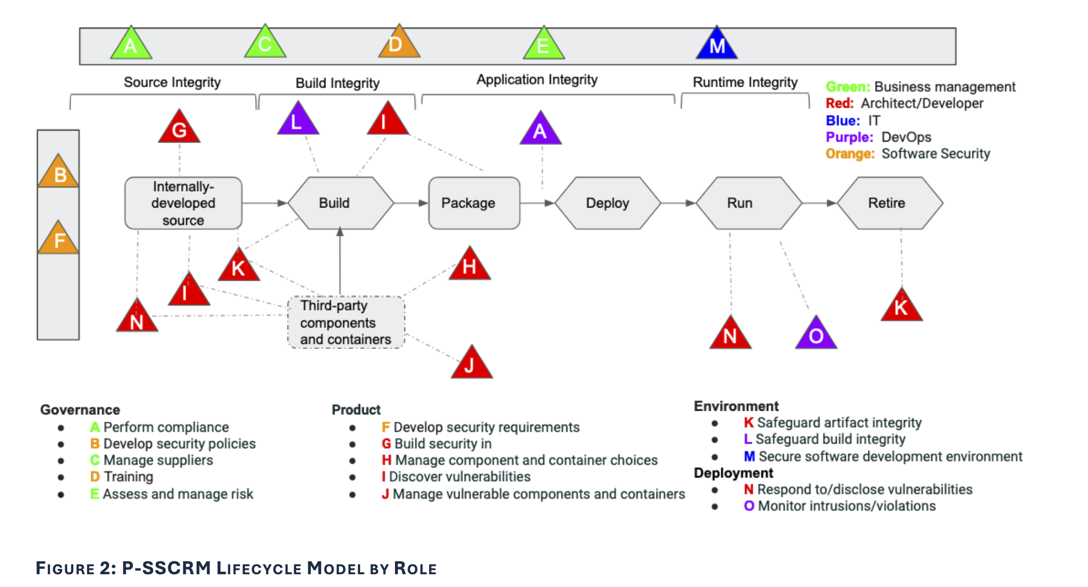
The diagram below displays the P-SSCRM groups and practices in the context of a product lifecycle model, annotating the primary role responsible for each practice. The practices and associated controls protect the integrity of source code, the build environment, deployed and running software applications. They also include practices to securely decommission a software product at its end of life. The practices that appear in solid boxes along the top and left side of the lifecycle indicate practices that are done throughout the product lifecycle.
WHO SHOULD USE THE P-SSCRM?
The ten frameworks were chosen because government and industry practitioners frequently talked about all ten at meetings and summits and on Slack and blogs during the months of development of P-SSCRM. As the controls of each framework were added to P-SSCRM, each control was analyzed for bi-directional equivalence with an existing P-SSCRM control. Two controls are bi-directionally equivalent if they have the same meaning but most likely different wording/phrasing in their definition in the different frameworks. A mapping was added when a control was considered equivalent to an existing control, and a new control was created otherwise.
We did the other mappings by reading the descriptions of the controls in the various documents to assess bi-directional equivalence. The mappings were freely distributed to interested parties for feedback over a six-month period. As each of the ten standards was considered for inclusion in the P-SSCRM, the strengths of each and their value in working together synergistically to provide a holistic view of software supply chain risk reduction by all five roles were realized. The number of controls in each of the four groups that came from each framework is shown in Table 1. The bolded numbers in Table 1 indicate the framework most influential in providing the controls for a group. Twenty of the 23 Governance controls came from the NIST 800-161 framework. The Business Manager and Software Security roles often conduct the practices of the governance group, for which NIST 800-161 provides broad coverage of P-SSCRM controls in this group, although it falls just short of providing 100% coverage of the P-SSCRM Governance group controls. Fourteen of the 19 Product controls came from the SSDF framework. Product controls are done by the Architect/Developer role, and the SSDF is a development framework. Thirteen of the 23 Environment controls came from the CNCF SSC framework. With its focus on the cloud environment, the CNCF SSC framework contains practices to protect the build infrastructure and computing environment. Finally, 5 of 8 controls from the Deployment group come from SSDF. The purpose of including the OpenSSF Scorecard metrics in the table is to provide a longitudinal status of the ability of software ecosystems to automatically detect evidence that a control has been conducted on a software product/project. Currently, only 6 Product, 2 Environment, and 1 Deployment controls can be automatically detected.
TERMINOLOGY & DEFINITIONS
- Control. Actions or efforts conducted in the process of implementing a secure software
application and of reducing the security risk of that application and for its producing
organization. Each control has a lower-level objective to aid in secure software development
and risk reduction. For example:
- P.3.1 Component and container choice: make informed third-party component and container choices
- Practice. A grouping of P-SSCRM controls that have a similar mid-level objective to aid in secure
software development and risk reduction. The 73 controls of the P-SSCRM are organized into 15
practices. For example,
- P.3 Manage component and container choices: software supply chain risk can be reduced by careful choice and handling of third-party components and containers.
- Group. A grouping of P-SSCRM practices with a similar high-level objective to aid in secure software development and risk reduction. The 15 practices of the P-SSCRM are organized into four groups: Governance, Product, Environment, and Deployment. o Product (P): Controls to lead to deploying a secure product with minimal vulnerabilities with associated required attestations and artifacts.
TABLE 1: CONTROL COUNTS BY FRAMEWORK AND PRACTICE
| Practice/Framework | P-SSCRM | 800-161 | BSIMM | CNCF-SSC | EO | OSSF-Scorecard | OWASP-SCVS | SLSA | SSDF | SSDF-AI | Self-attestation |
|---|---|---|---|---|---|---|---|---|---|---|---|
| G.1 Perform compliance | 5 | 3 | 5 | 4 | 3 | 3 | 4 | 4 | 4 | ||
| G.2 Develop security policies | 5 | 5 | 1 | 4 | 1 | 4 | 4 | 2 | |||
| G.3 Manage suppliers | 5 | 1 | 1 | 1 | 1 | 1 | 1 | 1 | 1 | ||
| G.4 Training | 3 | 3 | 2 | 2 | 2 | 1 | |||||
| G.5 Assess and manage risk | 2 | 4 | 2 | 2 | 1 | ||||||
| P.1 Develop security requirements | 1 | 2 | 1 | 2 | 1 | 1 | 1 | 2 | 2 | ||
| P.2 Build security in | 2 | 5 | 1 | 5 | 1 | 5 | 3 | 3 | |||
| P.3 Manage component and container choices | 2 | 3 | 4 | 1 | 1 | 2 | 1 | 1 | 1 | 1 | |
| P.4 Discover vulnerabilities | 4 | 4 | 3 | 5 | 3 | 3 | 1 | 5 | 5 | 5 | |
| P.5 Manage vulnerable components and containers | 2 | 1 | 1 | 2 | 1 | ||||||
| E.1 Safeguard artifact integrity | 2 | 5 | 2 | 1 | 5 | 3 | 2 | 2 | |||
| E.2 Safeguard build integrity | 2 | 7 | 2 | 3 | 4 | 6 | 3 | 2 | 2 | ||
| E.3 Secure software development environment | 7 | 1 | 6 | 1 | 1 | 1 | 1 | ||||
| D.1 Respond to/disclose vulnerabilities | 4 | 4 | 5 | 2 | 5 | 5 | |||||
| D.2 Monitor intrusions/violations | 1 | 2 | 1 | 1 |